Why Your Next Software Project Should Cost 90% Less
At the most recent World Economic Forum, a CEO of a leading global AI company dropped a bombshell: AI is projected to handle the majority, perhaps even all software engineering tasks within the next 6 to 12 months. This isn't a distant, five-year forecast; it is a shift happening right now. Within top-tier tech firms, engineers have already transitioned from writing original lines of code to primarily editing and auditing AI-generated scripts.
For business owners and stakeholders, this represents a fundamental paradigm shift. After building over 100 applications for global clients over the last five years, it is clear that the traditional software development lifecycle is being replaced by a more efficient, AI-centric model.
Watch full video guide here:
<iframe width="560" height="315" src="https://www.youtube.com/embed/GR7RcfxWuug" title="THIS is good news for business owners!" frameborder="0" allowfullscreen></iframe>The "Death of SaaS" and the Rise of Bespoke Internal Tools
The industry is entering an era where businesses no longer need to be held hostage by massive subscription fees for "bloatware" software that offers 100 features when only one specific "thin slice" is actually required.
The HubSpot Case Study
Consider a common scenario: a company utilizing HubSpot as their CRM requires a simple, custom ticketing add-on.
- The Traditional Quote: A $20,000 enterprise upgrade was quoted just to access that single feature.
- The Problem: The solution was overpriced and didn't perfectly align with the company’s internal workflow.
- The AI Solution: A non-technical marketing manager used AI to "vibe-code" the solution in just a few days.
The result? The organization now uses a custom tool that fits their exact process with zero additional subscription costs. This is the new reality: customization is becoming cheaper than subscription.
A New Engagement Model: From "Build" to "Refine"
The nature of professional software development has flipped. The "starting point" for a project is no longer a blank slate.
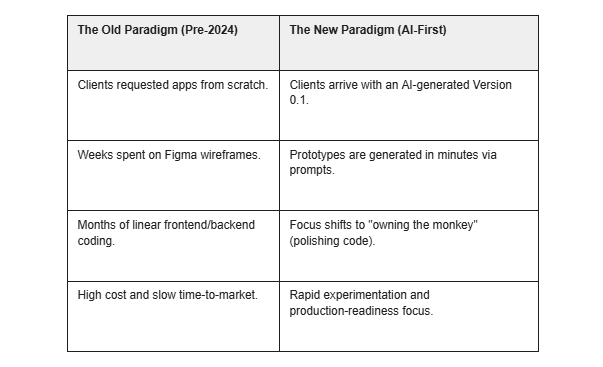
Today, founders and non-technical teams are using tools like Replit, Claude, and Cursor to build functional prototypes in hours rather than months. Agencies are no longer being hired to "build the house"; they are being hired to ensure the house is structurally sound, secure, and ready for occupants.
The 5-Minute Transformation
In the previous era, a basic ticketing system required design sprints, database architecture, and manual frontend engineering. Today, a functional version of that same system complete with priority status and dashboards can be generated in under five minutes.
While these AI-generated versions aren't "enterprise-ready" out of the box, they provide a 90% head start. If a development partner is still quoting months for basic wireframing and frontend setup, they are operating in a bygone era. The technology has moved faster than the traditional agency business model.
Strategy for the AI-First Business
Staying competitive in this landscape requires a shift in how resources are allocated:
- Stop Overpaying for SaaS: If a tool doesn't fit your business process, evaluate if an internal tool can be built in-house using AI.
- Empower Non-Technical Staff: Operations and marketing leads are often the best-positioned to "prompt" the tools they need into existence.
- Focus on the "Last Mile": Use professional engineering for what AI can't do perfectly yet: security, scalability, stability, and production-grade maintenance.
The cost and timeline of software have dropped dramatically. The focus should no longer be on how to code, but on how to solve business problems using the code AI provides.
Need help building your own AI Software? Book a call
Want to discuss this?
Book a call→