The problem
A UK university's nursing faculty had built something new: a virtual simulated placement. Students work through a full clinical day from home, managing a caseload of patients through AI conversations, recorded interactions, live actor consultations and written notes. The pilot worked, and other universities wanted it.
The timing matters. UK nursing students can now count up to 600 hours of simulated practice towards registration, double the old limit, while real placements are hard to find. Most simulation tools cover one patient in one encounter. A placement is a whole day.
But the pilot ran across several third-party and internal systems stitched together. It was fragile, hard to move and tied to one university's infrastructure. To offer it to other universities, the faculty needed a standalone platform.
The platform
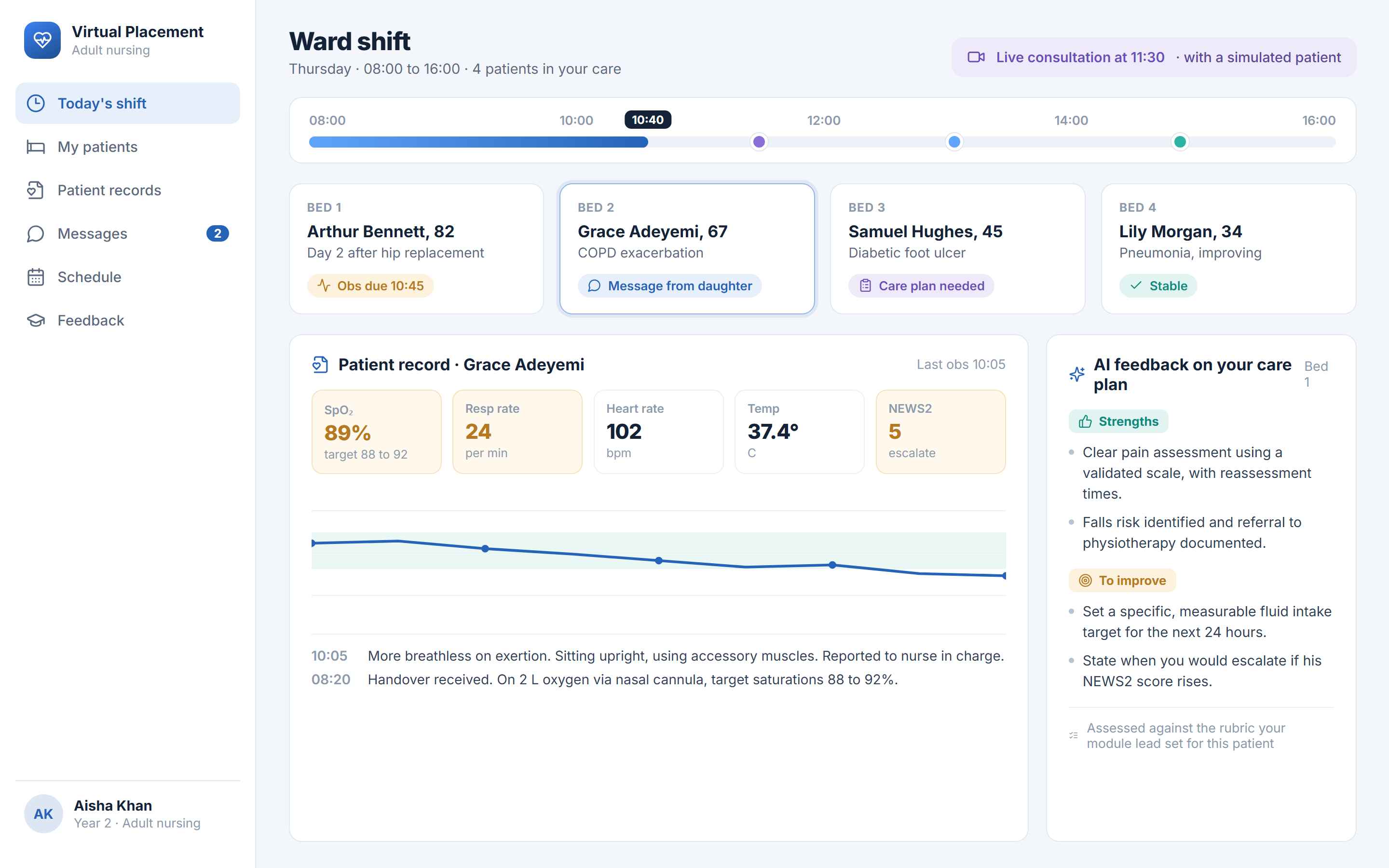
A full simulated shift. Students manage a caseload across a clinical day, moving between AI patients by text and voice, in-app messages, recorded interactions and scheduled sessions with live actors.
A patient record to work in. A simulated electronic patient record that students read and write to as they go, set up per scenario.
AI feedback on clinical documentation. Care plans, referrals and clinical notes are assessed by AI against the rubric staff set for each patient, alongside feedback from human assessors.
One platform, many universities. Each university is its own tenant, with departments, staff and student roles, so the platform can be licensed to other institutions and health disciplines.
How it started
Discovery ran as a series of working sessions with the faculty's simulation and digital learning leads. It produced user roles and flows, the architecture, a plan to move content out of the existing tools, a click-through prototype, and a cost model for AI voice at around 27,000 sessions a year per university, so the faculty knew its running costs before committing to the build.